
RIDGE RIDERS OF VALOR RIDGE
Episode One: The Work Before the Woods
Valor Ridge was not the sort of place people drove across the state to see.
There were no famous towers, no amusement parks, and no enormous signs announcing that something important had happened there. It had houses with bicycles lying in driveways, old fences beside new ones, dogs that barked at delivery trucks, a white-steepled church, a hardware store, a feed store, and enough open land at the edge of town for a child to disappear from adult sight without actually being very far away.
Which, as far as Bennett was concerned, made it nearly perfect.
The houses thinned as the roads climbed toward the northern edge of town. Beyond them came larger properties, irrigation ditches, scattered oaks, and open fields silvered with dry grass in summer and green after the rains.
And beyond all of that stood the woods.
They formed a dark line against the hills.
Bennett had seen those woods every day for as long as he could remember. He had built forts facing them, ridden his bicycle toward them, watched storms disappear into them, and thrown sticks for dogs at the edge of them.
Once, when he was six, he had announced his intention to live in them permanently. His mother had packed him a sandwich and asked whether he would be home for dinner.
He had been.
At nine years old, Bennett believed he knew the woods reasonably well.
This was because nine is an excellent age for confusing familiarity with knowledge.
On this particular morning, however, Bennett was not thinking about the woods.
He was thinking about math.
And he was losing.
"Seven plus eight," Mom said.
Bennett stared at the page.
Sunlight came through the kitchen windows and fell across the table directly onto his notebook, which Bennett considered suspiciously convenient.
Outside, Dad was already working. Bennett could hear the occasional scrape of a ladder against wood and the hollow knock of something being moved near the duck coop.
Farther down the yard stood the fence they had begun painting the previous afternoon.
Beyond that was Fort Resolute.
Beyond Fort Resolute were the fields.
And somewhere around eleven, if the entire civilized world behaved properly, Silas would arrive.
All of these things were waiting for Bennett.
The addition page was not.
"Seven plus eight," Mom said again.
"I heard you."
"I know."
"I'm thinking."
"I know that too."
Bennett leaned closer to the page.
Nothing improved.
Mom sat across from him with a coffee mug in one hand and a pencil in the other.
Their homeschool mornings did not always look the same.
Some days there were books stacked across the kitchen table and an actual schedule written in Mom's notebook. Some mornings began with Scripture and memory work, then writing, grammar, math, geography, and reading.
Other days became something else entirely.
A trip to the grocery store turned into percentages and unit prices. A broken sprinkler became a lesson about pressure and fittings. A bird's nest found beneath the patio roof could derail science for an hour. Dad could take a trip to the hardware store and somehow return with both lumber and a conversation about economics.
Mom believed in plans.
Dad believed plans ought to survive contact with reality.
Bennett mostly believed lunch should come sooner.
Somehow, between all three philosophies, he was being educated.
That morning they had begun with Scripture.
Mom had read from Colossians 3 and stopped at the words, "work heartily, as for the Lord."
Then she had closed the Bible.
"What do you think that means?"
Bennett had considered the question.
"Do good work."
"Why?"
"Because God sees it."
"Even if I don't?"
"Yes."
"Even if Dad doesn't?"
"Yes."
"Even if nobody ever knows?"
Bennett had hesitated.
That part seemed less convenient.
"Yes."
Mom had smiled.
"Write that."
So he had.
Now the words sat at the top of his notebook page:
Do good work even when nobody is checking.
At the time Bennett had believed that was the end of the lesson.
It was not.
Parents occasionally have the annoying habit of arranging for lessons to continue after the child believes class has ended.
"Finish the page," Mom said.
Bennett looked back down.
He worked the next problem, then another, then pushed the notebook toward her.
Mom examined it.
Her pencil stopped.
Bennett saw it stop.
"No."
"You haven't said anything."
"I can tell."
"From what?"
"Your face."
"My face didn't do anything."
"Your face confessed before you did."
She turned the notebook around.
A small pencil mark sat beside one problem.
"Try that one again."
"I was close."
"You were."
"So-"
"No."
Bennett dropped into the chair.
"That seems harsh."
"It is one math problem."
"It is the principle."
Mom's mouth twitched.
"Oh, now we care about principles?"
Bennett picked up his pencil.
He had rushed. He knew he had rushed. Silas was coming. Dad was outside. The day was happening without him.
He worked the problem again, slower this time.
When he finished, he handed the page back.
Mom checked it.
"Correct."
Bennett stood.
"Freedom."
"Chair."
He stopped.
The chair was halfway into the walkway.
He pushed it in.
"Freedom?"
Mom pointed toward his notebook.
"Take that."
"Why?"
"You might learn something."
"I'm going outside to paint."
"Exactly."
Bennett tucked the notebook beneath his arm.
He was beginning to suspect adults had conspired to make everything educational.

Dad was beside the duck coop when Bennett came through the back door.
The coop had taken most of a year to build.
Not continuously. If Dad had worked on it continuously for a year, even the ducks would probably have complained.
It had begun as several sketches, then measurements, then lumber stacked near the garage. After that came posts, walls, wire, doors, roof panels, drainage, hardware, changes to the drainage, changes to one of the doors, and one memorable afternoon in which Dad had stood perfectly still for almost a full minute before announcing that a measurement he had made the previous day was "unacceptable."
Bennett had learned that unacceptable was an adult word meaning somebody was about to redo several hours of work.
The coop now stood finished near the back fence.
Finished structurally, anyway.
Dad had spent enough time building it that he had apparently decided it deserved paint.
He wore an old shirt and work pants marked by years of projects. Dad was clean-shaven, which meant when he rubbed his jaw while thinking, there was no beard to hide whether he was irritated.
Bennett had become fairly good at reading that jaw.
Dad handed him a brush.
"Morning."
"Morning."
"School done?"
"Yes."
Dad looked toward the kitchen window.
Bennett corrected himself.
"Math done."
"More accurate."
"What are we doing?"
Dad pointed at the coop wall.
"You tell me."
Bennett examined it.
Most had been painted the day before.
"Second coat?"
"Eventually."
Bennett looked again.
Dad waited.
This was another adult trick. Dad could stand silently beside a problem until Bennett discovered it himself.
Then Bennett saw the missing strip.
Low on the wall, partly hidden behind a brace, was a patch of bare wood.
"Oh."
Dad nodded.
"I missed that."
"You did."
"I couldn't see it yesterday."
Dad crouched beside him.
"Can you see it now?"
"Yes."
"Did it stop needing paint because you couldn't see it?"
Bennett knew a trap when he heard one.
"No."
Dad handed him the brush.
Bennett dipped it.
Then stopped.
"You know, it's pretty small."
Dad straightened.
There it was.
The jaw.
"It's behind the brace," Bennett continued. "Nobody's really going to see it."
Dad folded his arms.
Bennett reconsidered several recent life choices.
"What?"
"Nothing."
"That's worse."
Dad almost smiled.
"Step back."
They walked ten feet from the coop.
"Now look at the wall."
Bennett did.
From there it looked finished.
Dad nodded toward it.
"Good?"
"Looks good."
They walked closer.
The bare strip appeared again.
Dad pointed.
"And now?"
"Not finished."
"Exactly."
Dad picked up a paint stirrer from the tray.
"There's a difference between something looking finished and something being finished."
Bennett looked at the missed wood.
"It's just paint."
"Today."
Dad pointed toward the fence.
"Yesterday it was paint there too."
Then toward the garage.
"Another day it might be a measurement."
He tapped the latch on the coop door.
"A latch."
He looked at Bennett.
"A promise."
Bennett said nothing.
Dad rarely raised his voice when he was serious.
That was how Bennett knew to listen.
"The habit doesn't know whether the job is important," Dad said. "You teach yourself how you work on the small things. Then one day something important shows up, and you bring the same person with you."
Bennett frowned at the wall.
"So everything has to be perfect?"
Dad shook his head.
"No."
That answer came quickly.
"You will make mistakes. I make mistakes. You've watched me tear things apart because I measured wrong."
"More than once."
"Thank you."
"You're welcome."
Dad pointed the paint stirrer at him.
"Doing it right the first time does not mean pretending you'll never make a mistake. It means you don't knowingly leave one once you find it."
Bennett looked again at the bare wood.
"That's different."
"It is."
"What if it doesn't matter?"
Dad shrugged.
"Sometimes it truly doesn't. Part of growing up is learning the difference."
That surprised Bennett. He had expected a speech about everything mattering.
Dad went on.
"But be careful with the words good enough. They're useful words when you know what enough means. They're lazy words when you don't."
He handed Bennett the brush.
"Remember what you read this morning."
Bennett knew exactly what he meant.
"Work heartily."
Dad nodded.
"For?"
"The Lord."
"So give Him work you're willing to put your name on."
Bennett crouched and painted the bare patch.
Then he noticed another thin line beneath it.
He painted that too.
They worked for more than an hour.
Dad taught him how much paint belonged on a brush. Less than Bennett thought. How to catch a drip before it dried. How to keep a wet edge. How to look underneath a board rather than trusting the angle from above. How to clean paint from hardware before it became permanent.
And, most importantly, how paint could somehow reach one's elbow even when one's elbow had never knowingly entered the paint tray.
They moved from the duck coop to the backyard fence.
Bennett began quickly.
The first boards were satisfying.
Roller up.
Roller down.
Bare wood disappeared beneath clean paint.
Progress was obvious.
After twenty minutes, however, the fence continued being a fence.
There were more boards.
And more.
And still more.
Bennett slowed.
Then hurried.
The work became less interesting precisely when careful work became more necessary.
Dad was painting several yards away.
Bennett looked at the board in front of him.
A narrow strip near the bottom was thin. He could see wood showing through.
He rolled past it.
Then stopped.
Nobody had said anything.
Dad had not seen it.
Mom was inside.
The board was low.
Bennett stared at it.
Do good work even when nobody is checking.
He sighed.
Sometimes Scripture was considerably more convenient when it remained in the Bible.
Bennett rolled back over the missed area.
Then he crouched.
Checked the bottom.
Found another.
Fixed it.
He moved on.
Several minutes later Dad appeared beside him.
Bennett continued painting.
Dad examined the finished boards.
"You went back."
Bennett looked over.
"You saw?"
"No."
"Then how do you know?"
Dad pointed at the lower edge.
"You've got paint on both knees."
Bennett looked down.
Dad smiled.
"Good work."
Two words.
Nothing more.
But Bennett felt something settle into place inside him.
Not because the fence looked good.
Because he knew why it looked good.
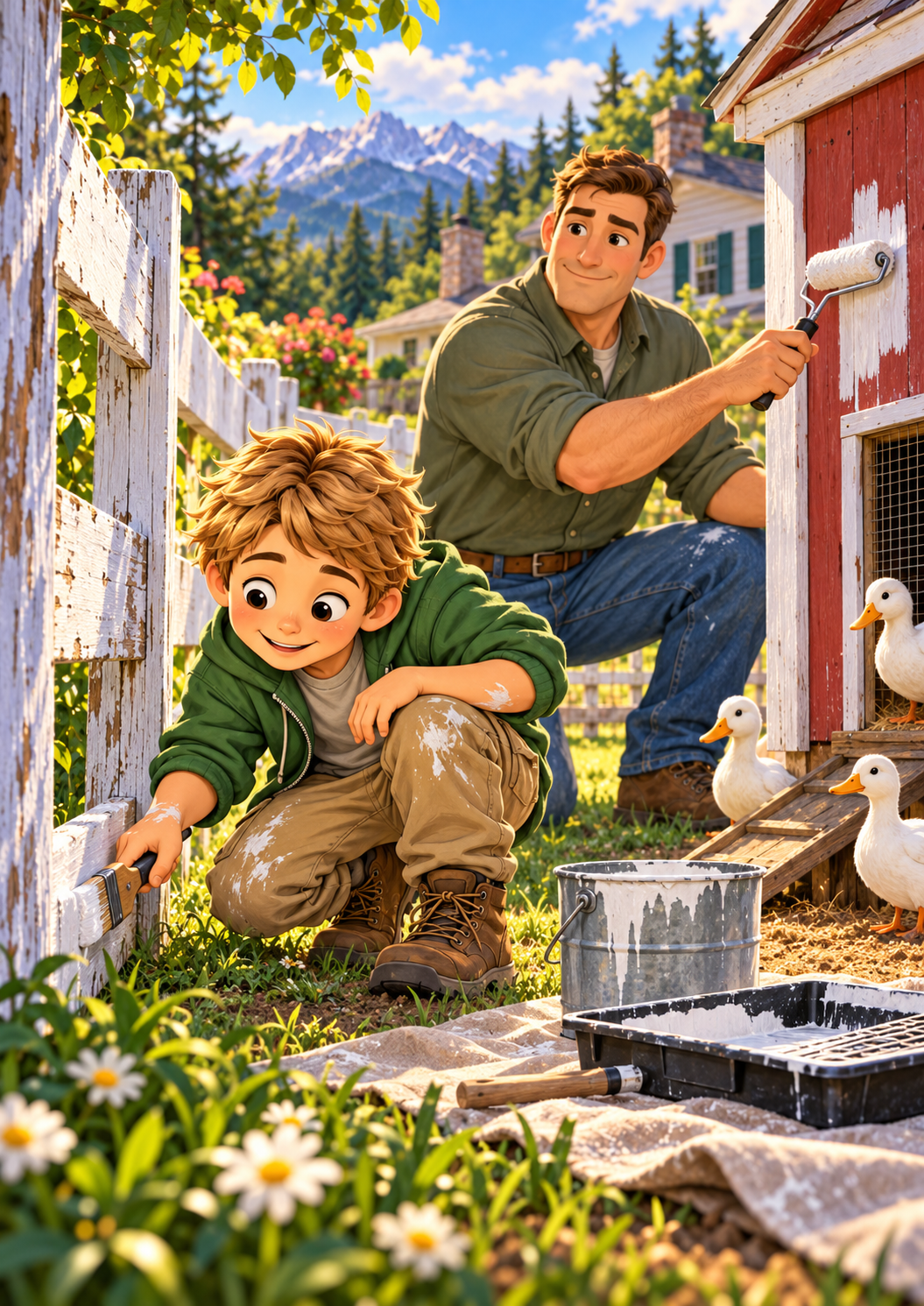
Mom came outside carrying three bottles of water.
She handed one to Dad and one to Bennett.
"What happened to you?"
Bennett looked down.
Paint marked his forearm, both knees, one shoelace, and somehow the back of his wrist.
"I painted."
"I can see that."
"I did most of that section."
Mom looked over the fence.
"It looks good."
Bennett smiled.
Dad took a drink.
"Tell her about the coop."
Bennett's smile faded.
"Why?"
"Because it's part of the story."
Mom raised an eyebrow.
"What part?"
Bennett explained the missed strip.
"And I was going to leave it."
"You considered leaving it," Dad corrected.
"That sounds better."
"It does."
"But I didn't."
Mom looked at him.
"Why not?"
Bennett drank some water.
"Because it wasn't done."
She waited.
Bennett knew the waiting trick.
Adults apparently received formal training in it.
"And because of what we read."
"What did we read?"
Bennett groaned.
"You know."
"I do."
"Then why do I have to say it?"
"Because you knowing what I know is not the same as you knowing it."
Dad pointed at Mom with his water bottle.
"That one's worth writing down."
"Do not encourage her."
Mom smiled.
Bennett finally said, "If I'm working for God, then I shouldn't purposely do lazy work just because nobody will notice."
Mom nodded.
"Better."
"Better than what?"
"Your answer this morning."
"Can I change it?"
"Of course."
"Do I have to write it again?"
"Of course."
Bennett looked at Dad.
"You married her."
"I did."
"On purpose?"
"Best decision I ever made."
Mom smiled at Dad.
Bennett made a face.
"Gross."
"Someday you'll understand."
"I hope not."
The knock at the side gate saved him.
Three quick taps.
Two slow.
Bennett looked up.
"Silas."
He dropped the water bottle onto the worktable and headed toward the gate.
"Brushes," Dad said.
Bennett stopped.
Silas knocked again.
Three quick.
Two slow.
"Dad."
"Brushes."
"He's here."
"And?"
"He's waiting."
Dad looked at the brush in Bennett's hand.
Bennett looked at the brush.
This was clearly unjust.
He walked toward the utility sink.
Dad called after him.
"Tray too."
Bennett closed his eyes.
Silas knocked again.
Dad added, "And the roller."
"This is oppression."
Mom walked back toward the house.
"Add vocabulary to today's school record."
Silas sat on the low wall beside the gate when Bennett finally came around the house.
"You took forever."
"I had responsibilities."
Silas looked him up and down.
"You lost a fight with a paint can."
"I won."
"It doesn't look like you won."
"You should see the fence."
Silas stood.
He had dark, slightly wavy hair, a narrower face than Bennett's, and the habit of looking at things for several seconds before commenting on them.
Bennett generally entered a room as though the room had been waiting for him.
Silas preferred to determine whether the room deserved it.
They were the same age.
They were not the same boy.
This fact had saved both of them from several terrible ideas.
"You ready?" Bennett asked.
"For what?"
"The fort."
"What are we doing?"
"Roof."
"What kind?"
"A better one."
Silas stared at him.
"What?"
"You don't know."
"I know we need a roof."
"That isn't a plan."
"It's the beginning of one."
"That is exactly what you said before the first roof."
"The first roof almost worked."
"It fills with water."
"Only when it rains."
Silas continued staring.
Bennett pointed toward the house.
"Mom said you can eat."
"I assumed."
"You shouldn't assume."
"Your mom feeds me every time I come over."
"That is evidence, not certainty."
Silas nodded thoughtfully.
"That sounded like homeschool."
"Don't start."
At lunch, Mom put sandwiches, apple slices, and carrots on the table.
Silas ate like someone who had been invited to a meal and intended to honor the invitation thoroughly.
Dad came inside after washing up.
"So," he said. "Fort Resolute."
Mom looked at him.
"You encourage the name."
"I recognize sovereign territory."
"It is six pieces of scrap lumber and a tarp."
"Every nation begins somewhere."
Bennett pointed at Dad.
"Exactly."
Mom looked at Silas.
"You see what I deal with?"
Silas nodded solemnly.
"I do."
"Traitor," Bennett said.
Dad finished half his sandwich.
"What's the objective?"
"Fix the roof."
"How?"
Bennett opened his mouth.
Silas reached into his pocket and unfolded a sheet of paper.
Dad took it.
Bennett stared.
"You made drawings?"
"Three."
"Three?"
"The first design was bad."
"You never showed me a first design."
"That's because it was bad."
Dad studied the paper.
Silas had drawn the two trees that supported the fort, a ridgepole between them, diagonal braces, and rough measurements.
"What's this angle?" Dad asked.
"Brace."
"Why?"
"The pole twists."
Dad nodded.
Bennett leaned over.
"The pole does not twist."
Silas looked at him.
"It absolutely twists."
"Barely."
"Barely twisting is still twisting."
Bennett looked at Dad.
Dad said, "That sounds familiar."
Bennett took another bite of sandwich.
"I liked my life better before everybody started using my own lessons against me."
Mom said, "It's been about two hours."
"Exactly."
Dad returned the drawing.
"Anything else?"
"Canvas over the ridge," Silas said. "Pitch it toward the back so water runs off."
Bennett nodded.
"That part was my idea."
"It was."
Dad looked at Bennett.
"You have a drawing?"
Bennett pointed at Silas.
"I have Silas."
Silas folded the paper.
"That is not a long-term planning strategy."
"It has worked so far."
"Mostly."
Dad laughed.
Then his expression changed slightly.
Not stern.
Just serious enough that both boys noticed.
"Boundaries."
Bennett began automatically.
"Back by dinner."
"Earlier if weather changes."
"Stay this side of the north fence."
Silas added, "No creek crossing without an adult."
"If either of you thinks something is unsafe?"
"Both stop."
"If you disagree?"
"We stop and figure it out."
"If one of you gets hurt?"
"Whistle, then come back or get help depending on what happened."
Dad nodded.
Mom pointed a carrot at them.
"And?"
Bennett and Silas answered together.
"No adventure is improved by making Mom call search and rescue."
Mom smiled.
"My finest contribution."
Dad looked at both boys.
"Freedom follows responsibility."
Bennett had heard that one before.
So had Silas.
Neither complained.
They both understood the arrangement.
Their parents gave them a great deal of freedom.
The price was that rules mattered even when no adult was standing beside them.
It was a price Bennett was beginning to understand was worth paying.
The afternoon belonged to them.
There are few forms of wealth a nine-year-old understands better than an afternoon with nothing scheduled.
Bennett and Silas carried rope, water, the tarp, Silas's drawings, Bennett's notebook, two hammers, and a bucket of hardware Dad had approved for use.
Fort Resolute stood at the edge of the rough grass behind Bennett's property.
Calling it a fort required generosity.
Calling it architecture required dishonesty.
It consisted of two trees, several pieces of lumber, a platform barely high enough to deserve the name, a tarp roof, and one crooked sign on which Bennett had painted:
FORT RESOLUTE
Silas had suggested using a level.
Bennett had explained that frontier forts were not famous for typography.
The old roof sagged between the supports.
One corner had come loose.
Silas put both hands on his hips.
"Beautiful."
"It survived."
"So do weeds."
Bennett climbed onto the low platform.
"Give me the rope."
"No."
"Why?"
"Look at the ridgepole."
Bennett looked.
"It's fine."
"Look from here."
Bennett came down.
From Silas's angle, the pole leaned noticeably.
"Huh."
"That's what I said yesterday."
"You did not say 'huh.'"
"I said it was twisting."
"Same idea."
Silas knelt beside one support.
"And this knot is loose."
"It held."
"So did the roof."
"Exactly."
"And the roof is terrible."
Bennett looked toward the house.
Silas watched him.
"What?"
"Nothing."
"You're doing that thing."
"What thing?"
"The quiet thing where you're trying to make me think."
Silas shrugged.
"I was wondering what your dad would say."
Bennett glared.
"That is an extremely cheap move."
"Did it work?"
Bennett looked at the loose lashing.
"Yes."
They took the roof apart.
This was deeply irritating.
Taking something apart after already building it feels less like progress than almost anything else in the world.
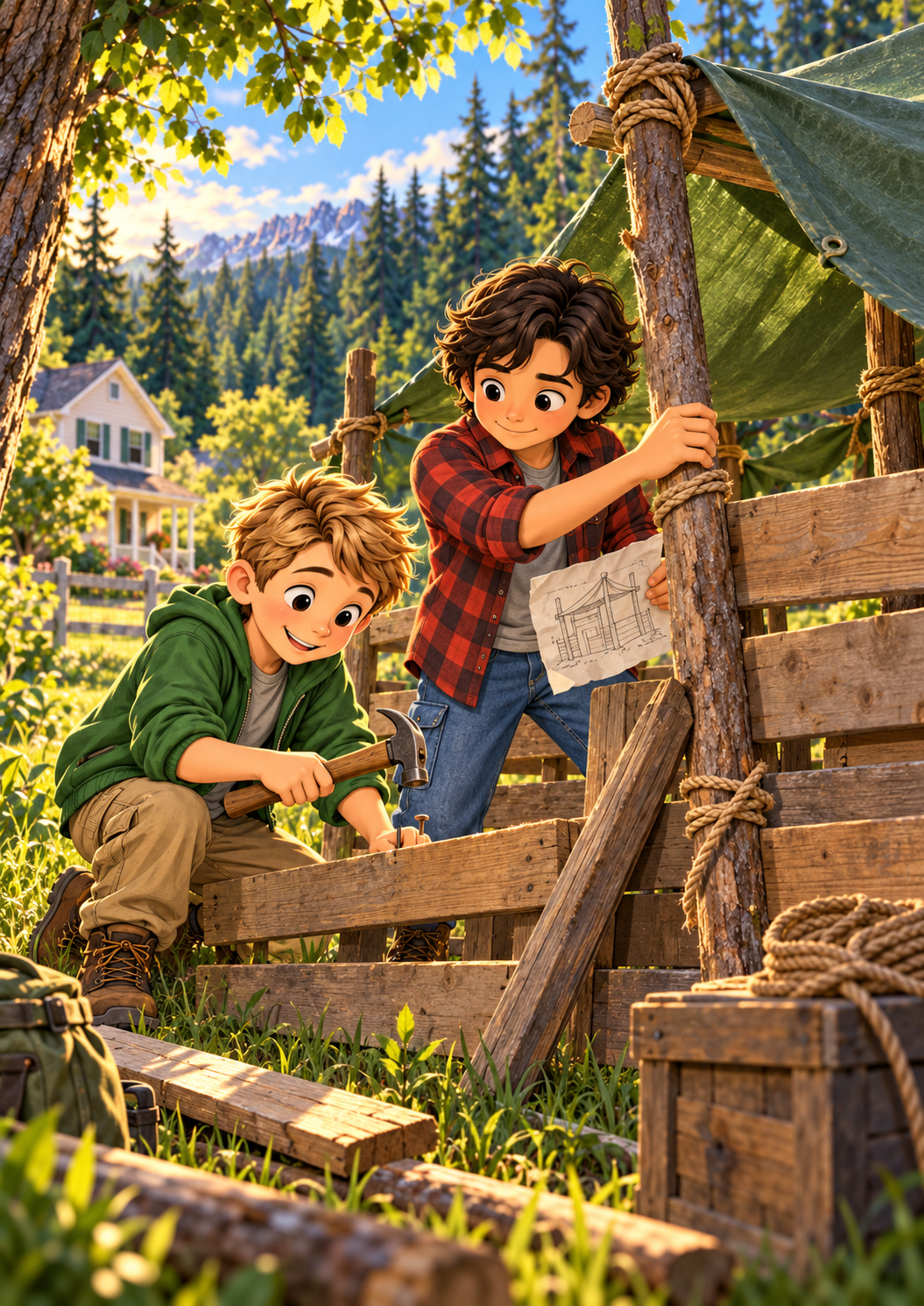
Silas held the ridgepole while Bennett retied the support.
Then they changed sides.
Then the diagonal brace did not fit.
Silas measured.
Bennett measured.
They got different numbers.
"You're wrong," Bennett said.
"Possible."
"That's it?"
"One of us is."
Bennett measured again.
Silas waited.
Bennett stared at the tape.
"I'm wrong."
"Also possible."
"You could act surprised."
"I could."
Bennett threw a short piece of rope at him.
Silas laughed.
They corrected the measurement.
Then the brace fit.
An hour later the tarp sat tight over the ridgepole with enough pitch for rain to run toward the back.
The structure felt solid.
Silas pulled on the support.
Nothing moved.
Bennett pulled harder.
Still nothing.
"Now," Silas said, "it's a roof."
Bennett sat beneath it.
"You're welcome."
"For what?"
"My leadership."
Silas sat beside him.
"I drew it."
"I inspired you to draw it."
"You inspired me to prevent the old roof from falling on my head."
"Leadership."
Silas opened his water.
"Sure."
After a few minutes Bennett took out his notebook.
Silas noticed.
"You doing school?"
"No."
"You have a notebook."
"I'm drawing the fort."
Silas leaned over.
Bennett had sketched the two support trees and roofline. Beside them were several measurements.
Silas said nothing.
Bennett kept drawing.
Silas remained silent.
Finally Bennett looked at him.
"What?"
"Nothing."
"What?"
"I am enjoying the moment."
"What moment?"
"You voluntarily put measurements in a notebook."
"It's not math."
Silas pointed.
"Numbers."
"It's building."
"Math wearing boots."
Bennett threw a pinecone.
Silas ducked.
The pinecone bounced off the edge of the platform and rolled down the slope toward the fence.
Silas climbed down after it.
He was gone only a few seconds before Bennett heard him.
"Hey."
Something in Silas's voice had changed.
Not fear.
Attention.
Bennett put down the notebook.
"What?"
"Come here."
Silas stood near the north fence.
At that end of the property, the fence separated the rough backyard from a strip of field that eventually sloped toward the woods.
Bennett joined him.
Silas pointed at the ground.
"What is that?"
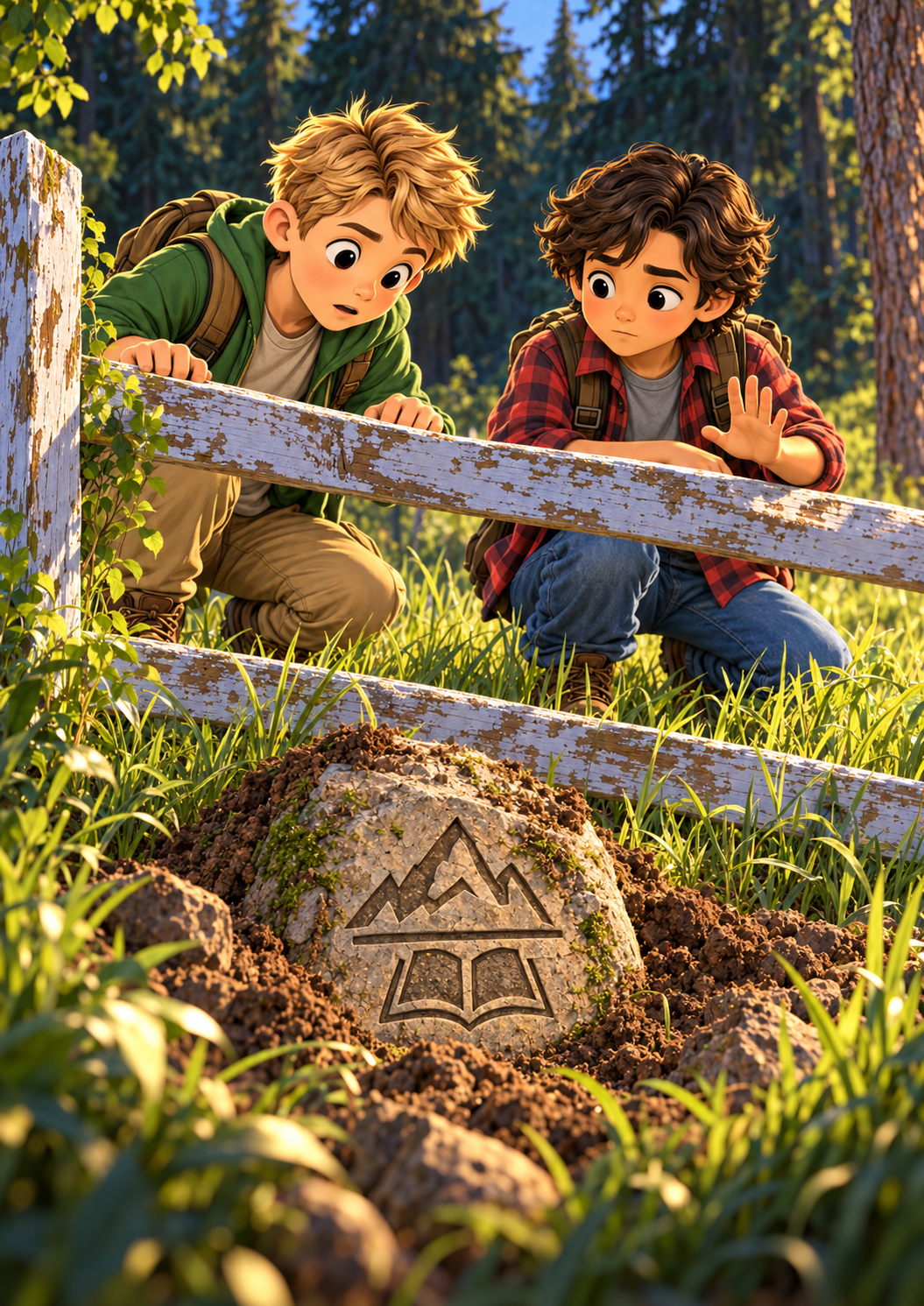
Near the base of the fence, rain and erosion had exposed the upper edge of a flat stone.
Valor Ridge had plenty of stones.
This one was different.
It was almost rectangular.
Dark gray.
Its visible edge was too straight.
Bennett crouched.
"Was that there before?"
"You live here."
"I don't remember it."
"You've been down here a million times."
"So have you."
Silas picked up a fallen twig and carefully cleared leaves away from their side of the fence.
More of the stone appeared.
It sat mostly on the other side.
There was something carved into it.
Bennett moved closer.
The mark was worn.
A peaked shape at the top.
A line beneath it.
Another shape below that.
Silas squinted.
"Mountain?"
"Looks like one."
"What's underneath?"
Bennett gripped the upper fence rail and leaned toward it.
The lower symbol looked like two angled shapes meeting in the center.
"Book?"
"Maybe."
"Could be wings."
"Why would somebody carve wings under a mountain?"
"Why would somebody carve a book?"
Bennett lifted one boot toward the lower rail.
Silas immediately said, "No."
"I'm not crossing."
"That is literally what the fence is."
"I'm just getting closer."
"On the other side."
"My whole body isn't going over."
Silas gave him a look.
"What percentage of your body has to cross before you've crossed?"
Bennett lowered his boot.
"That sounded like math."
"I learned from the best."
"The rule is dumb."
Silas shrugged.
"Maybe."
Bennett looked at him.
"You agree?"
"I didn't say we should break it."
That annoyed Bennett even more.
The stone sat less than three feet away.
If he climbed onto the lower rail and leaned-
He could reach it.
Probably.
He pictured Dad asking whether he had crossed the fence.
He pictured himself explaining that only his upper body had crossed.
It sounded worse inside his head than it had outside.
Bennett stepped back.
"Fine."
Silas nodded.
"But we can still look."
"Yep."
Bennett opened his notebook.
He drew what they could see.
Mountain.
Line.
Book-or wings.
Silas used the stick to shift another tuft of dead grass.
"Wait."
"What?"
"There's more."
Near the bottom of the exposed stone were three shallow cuts.
They might have been letters once.
Time had softened them.
Bennett copied those too.
One looked like an R.
The second could have been almost anything.
The third looked like another R-or maybe a B.
Silas sat back on his heels.
"Someone made this."
"Obviously."
"I mean a person. On purpose."
"Also obviously."
Silas looked toward the woods.
Bennett followed his eyes.
The afternoon wind passed through the field in long waves. Dry grass bowed and rose again. Beyond it, the tree line stood dark beneath the hills.
"How old do you think it is?" Silas asked.
"No idea."
"Your dad ever show you this?"
"No."
"Your mom?"
"No."
"Do they know it's here?"
Bennett looked again at the carving.
He suddenly wanted very badly to know.
"We'll ask."
Silas stood.
Bennett remained crouched for another moment.
The stone had probably been there for years.
Maybe longer than the house.
Maybe longer than the fence.
There was nothing particularly frightening about it.
Still, Bennett felt the tiny prickling sensation that sometimes came when the ordinary world turned one degree and became something else.
He looked again at the woods.
For just a moment, between two trees, he thought he saw movement.
Not an animal exactly.
Not anything he could name.
Just a darker shape passing through darkness.
He blinked.
Nothing.
Silas was already gathering the rope.
"You coming?"
Bennett looked at the stone once more.
Then closed the notebook.
"Yeah."
They left it where it was.
That decision would matter later.
For now, it meant only that two boys did what they had said they would do.
They came home before dinner.
Silas stayed for dinner.
His mother had already arranged it with Mom, and by now he had eaten at Bennett's table often enough that nobody treated him like company.
Mom simply put out another plate.
Roasted chicken, potatoes, and green beans disappeared quickly.
For several minutes the only important matter in the world was food.
Then Dad leaned back.
"All right."
Bennett knew the tone.
Silas did too.
Dad looked at them.
"Report."

Mom remained at the table.
This was how the family did it after something important, unusual, difficult, or particularly stupid.
Sometimes the report took five minutes.
Sometimes it took half an hour.
Dad called it an after-action report.
Mom said that sounded like everyone should be wearing uniforms.
Dad said the name was accurate.
Mom said marriage involved choosing one's battles.
The name had stayed.
Dad folded his hands.
"What happened?"
Bennett started with the fort.
Silas interrupted twice to correct details.
Bennett accused him of disloyalty.
Silas argued that accuracy and loyalty were not enemies.
Dad agreed with Silas, which Bennett considered an unfortunate development.
They explained the crooked ridgepole.
The loose lashings.
Taking the roof apart.
Measuring.
Measuring again.
The finished structure.
"What went well?" Dad asked.
Silas answered first.
"We stopped when we knew the first plan wasn't working."
Dad nodded.
Bennett added, "We fixed the whole thing instead of trying to hide the bad part."
Dad glanced at him.
"Sounds familiar."
Bennett knew he meant the paint.
Mom knew too.
"What didn't go well?" Dad asked.
"I wanted to keep the first roof."
"Why?"
"Because taking it apart was annoying."
"Was that the real reason?"
Bennett thought.
"No."
"What was?"
He poked one potato with his fork.
"I didn't want to admit Silas was right."
Silas immediately sat taller.
Dad pointed at him.
"Do not ruin the moment."
Silas settled back down.
"Yes, sir."
Mom hid a smile.
Dad looked at Bennett again.
"What did you do?"
"Took it apart."
"Good."
Then Bennett remembered the notebook.
"The stone."
Dad's face remained still.
"What stone?"
Silas looked at Bennett.
Bennett stood, went to the counter, and brought back his notebook.
He opened it to the sketch.
"There's this thing by the north fence."
Dad took the notebook.
His eyes moved across the drawing.
For one second-maybe less-something happened to his expression.
Bennett would not have noticed it if he had not spent nine years learning his father's face.
Dad's thumb stopped on the page.
Mom noticed too.
Bennett saw her look at him.
Silas, naturally, saw all of it.
"What side of the fence?" Dad asked.
"Mostly outside."
"Did you cross?"
"No."
Dad looked directly at Bennett.
Bennett held his gaze.
"I almost climbed the lower rail to reach it."
Silas said, "He didn't."
Dad looked at Silas.
"Did you?"
"No, sir."
"Why not?"
Silas shrugged.
"Rule was clear."
Dad nodded.
Then he looked back at Bennett.
"What stopped you?"
Bennett wanted to give the best answer.
Dad had an irritating ability to tell when he did that.
So he gave the true one.
"First, Silas."
Silas smiled.
"Then I thought about what I was going to say when you asked."
Dad leaned back.
"That's not a bad reason."
"It felt like a bad reason."
"No. Learning to hear my voice when I'm not standing there is part of becoming responsible."
He tapped the notebook.
"Eventually it needs to become your voice."
Bennett looked at the drawing.
"So what is it?"
Dad did not answer.
Silas glanced at Mom.
Mom was watching Dad.
Bennett leaned forward.
"You know."
Dad looked at him.
"I know what?"
"The mark."
"I didn't say that."
"You did with your face."
Mom lowered her head.
Dad looked at her.
"Do not encourage him."
"I said nothing."
"You're saying plenty."
Bennett pointed.
"See?"
Dad closed the notebook.
"What did you promise me before you went out?"
"Stay inside the fence."
"And?"
"Come home before dinner."
"Did you?"
"Yes."
Dad slid the notebook back to him.
"Then that part of the report is good."
"That still isn't an answer."
"No."
"When do I get an answer?"
Dad took a drink of water.
"When an answer will help you more than the question."
Bennett stared.
"That sounds like something adults say when they don't want to answer."
"It is also occasionally true."
Silas whispered, "I'm writing that one down."
Bennett kicked him lightly beneath the table.
Mom saw.
Of course she did.
Dad continued.
"What would you do differently tomorrow?"
Bennett thought about the day.
"The math slower."
Mom nodded approvingly.
"The paint right the first time."
Dad raised a finger.
Bennett corrected himself.
"Or fix it when I see it."
"Better."
"The fort-I'd use the drawing before we start."
Silas looked delighted.
Bennett held up a hand.
"Do not speak."
Silas closed his mouth.
Dad asked, "And the fence?"
Bennett looked at the stone in his notebook.
"I'd still want to cross."
Dad waited.
"But I wouldn't."
"Why?"
"Because the rule didn't stop being the rule just because I wanted what was on the other side."
Dad nodded.
Mom asked the question she usually saved for last.
"What do you want to remember from today?"
Silas answered first.
"Bad plans don't become good plans because you already started."
Dad smiled.
"That's strong."
Bennett sat quietly.
The day moved through his head.
The wrong math answer.
The missed paint.
The fence boards.
The crooked roof.
The loose knot.
The old stone.
Finally he said, "Something isn't finished just because I'm tired of working on it."
Silas nodded.
Mom did too.
Dad said nothing for several seconds.
Then:
"Write that down."
Bennett dropped his forehead onto the table.
Silas laughed.
Later, after Silas had been picked up and the kitchen was clean, Bennett sat on the edge of his bed.
His notebook lay open.
Mom stood at the doorway.
He wrote slowly:
Something isn't finished just because I'm tired of working on it.
"There."
Mom walked in.
"Looks good."
"You're checking my handwriting now?"
"No."
She sat beside him.
Bennett looked at the sketch of the stone.
"Dad knows what it is."
"Maybe."
"You know too."
Mom smiled.
"You get that face from him."
"What face?"
"The one you make when you think persistence and interrogation are the same thing."
Bennett shut the notebook.
"Why won't you tell me?"
Mom considered him.
Then she smoothed the blanket beside her.
"Do you remember when you were little and wanted to use Dad's saw?"
"Which saw?"
"Exactly."
Bennett smiled.
"You said no because I was too young."
"I said no because you didn't yet know enough to use it safely."
"That is the same thing."
"It isn't."
She touched the notebook.
"Sometimes information is like a tool. The question isn't whether you deserve it. The question is whether you know what to do with it once you have it."
Bennett looked down.
"Am I too young?"
"I didn't say that."
"You people are impossible."
Mom laughed softly.
Then she leaned over and kissed the side of his head.
This time Bennett did not pretend to hate it.
"Goodnight."
"Night."
She reached the door.
"Mom?"
"Yes?"
He looked at the sentence he had written.
"If you do your best and it still goes wrong, was it bad work?"
Mom leaned against the doorframe.
"That depends."
"On what?"
"Did you learn?"
Bennett thought.
"Yes."
"Did you tell the truth about what went wrong?"
"Yes."
"Did you correct what you could?"
"Yes."
"Then failure and laziness are not the same thing."
She turned off the overhead light, leaving only his bedside lamp.
"Don't confuse them."
"Okay."
"And Bennett?"
"Yeah?"
"I was proud of your math too."
He stared at her.
"The one I got wrong?"
"The one you went back and learned."
Then she left.
Bennett sat there for another moment.
That answer bothered him in a good way.
He put the notebook on his nightstand.
Outside his window the freshly painted duck coop stood pale beneath the yard light.
Beyond it was the fence.
Beyond the fence, the field.
And beyond the field, the woods.
The stone could not be seen from here.
Bennett could see it anyway.
Mountain.
Line.
Book.
Or wings.
He wondered who had carved it.
He wondered how long it had been buried.
He wondered why Dad knew.
Most of all, he wondered why nobody wanted to tell him.
Eventually the questions blurred together.
His eyes closed.
And Bennett fell asleep.
Dad waited until the light under Bennett's bedroom door disappeared.
Then he walked into the garage.
Mom followed several minutes later.
Dad stood at the workbench.
"You handled that well," she said.
"I avoided answering our son."
"You handled that well."
Dad gave her a look.
She smiled.
"You knew immediately."
He opened the bottom drawer of the workbench.
Tools lay inside.
He moved a folded shop towel.
Then an old canvas pouch.
Beneath it sat a small leather case.
Mom's smile faded.
Dad picked it up.
For a moment he simply held it.
"How long has it been?" Mom asked.
"Long enough."
"That is not a number."
"No."
"You and Bennett are more alike than you think."
"I am aware."
Dad opened the case.
Inside lay an old brass compass.
It was not shiny.
Whatever polish it had once possessed had been worn away by years of hands, pockets, weather, and use.
The lid bore several scratches.
One edge carried a small dent.
Dad lifted it carefully.
The needle trembled.
Turned.
Settled north.
Then he flipped the compass over.
On the back, nearly worn smooth, someone had carved three shapes.
A mountain.
A line.
And beneath them-
an open book.
Mom looked toward the ceiling, toward the room where Bennett slept.
"He found the marker without crossing."
Dad nodded.
"And came back when he was supposed to."
Another nod.
"He told you he almost broke the rule."
Dad ran his thumb across the old symbol.
"Yes."
Mom watched him.
"You're proud of him."
"Yes."
"Then why do you look worried?"
Dad closed the compass in his hand.
"Because finding the first marker is not the same thing as being ready for what comes after it."
Mom was quiet.
Then:
"Were you?"
Dad looked at her.
"When you found yours?"
For the first time that evening, he smiled.
"No."
"That's what I thought."
He placed the compass back in its case but did not return it to the drawer.
Mom noticed.
"Not tonight?"
"No."
"Soon?"
Dad looked toward the dark kitchen window.
Past his own reflection, the backyard disappeared into shadow.
Fence.
Field.
Woods.
"Soon."
He closed the drawer.
Neither of them saw what happened beyond the north fence.
The wind had gone still.
The field no longer moved.
Yet at the edge of the woods, one low branch slowly lifted-as though something had just passed beneath it.
Then it settled back into place.
And Valor Ridge was quiet again.
For now.

THE RIDGE REPORT
Episode One: The Work Before the Woods
Every Rider learns to look back before moving forward.
Bennett and Silas gave their report. Now the reader gets a turn.
LOOK BACK
What happened in this episode that seemed ordinary at first but turned out to matter?
OWN IT
Where did Bennett make a good decision when nobody was forcing him to make it?
CORRECT IT
Which choice would you have handled differently: the rushed math, the missed paint, the bad fort roof, or the fence?
FIND THE TRUTH
Read Colossians 3:23 together. What is the difference between doing something perfectly and doing it faithfully?
CARRY IT FORWARD
Choose one ordinary job this week-schoolwork, cleaning, building, practice, or helping at home-and finish it with enough care that you would be willing to put your name on it.